
managers said the weaker rupee, which has driven up shares of technology companies, has helped the fund fetch better returns.

None of the four benchmarks suggested by the RBI is ideal as banks in India create loan assets from their deposits and not borrowing from the regulator or market, says Tamal Bandyopadhyay.

The three year lock-in period enables ELSS fund managers to invest in high conviction stocks for a long period of time because of relatively less redemption pressure, says Dwaipayan Bose

Here's the list of top 10 tax saving mutual funds for the period between November 28, 2006 and November 27, 2007. Their gains far outperform the gains made by the Sensex during the given period.
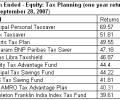
Mutual funds, especially the tax saver variety seems to be on a roll. Here's the list of top 10 ELSS mutual funds for the period ending September 28, 2007. These ELSS funds have made more money for you than the Sensex gains.

The net inflows into active equity mutual fund (MF) schemes registered more than a twofold month-on-month rise in August, crossing Rs 20,000 crore, the highest in five months. This rise in net inflows was boosted by an 18 per cent growth in gross investments, driven by a record Rs 15,800 crore inflow through the systematic investment plan (SIP) route and Rs 5,000 crore collected by seven new fund offers (NFOs) in the active equity space, reveals data released by the Association of Mutual Funds in India (Amfi). Moreover, redemptions moderated in August, declining by 19 per cent to Rs 24,580 crore, after staying elevated in the previous three months owing to profit booking.

Between April 2 and July 8 this fiscal, the rupee has plummeted by 12.81 per cent, and hit all-time low of 61.21 per cent on Monday.

Shrinking inflows and surging outflows on account of profit-booking has curtailed mutual fund (MF) investments in equities since April. The total investments made by equity MFs during the first three months of 2023-24 stands at just Rs 2,980 crore, compared with an average monthly investment of Rs 14,500 crore in 2022-23, reveals data from the Securities and Exchange Board of India. "We are seeing signs of moderation in non-systematic investment plan (SIP) contribution, which has impacted domestic fund inflows in recent months to some extent," says Kunal Vora, head-India equity research, BNP Paribas.

Shares of Avenue Supermarts (DMart) have rallied 15 per cent in the past month, even as the benchmark National Stock Exchange Nifty has remained flat. The stock has garnered favourable commentary from both fundamental and technical analysts after three years of poor performance. "DMart has reached its first 52-week high since October 2021, taking off from solid base formations.

The biggest bounce is in the realty sector, where the industry index jumped 80%. There's been a turnaround also in automobiles and ancillaries (up 45%). The pharma and health care indices have a welcome return of roughly 35%.

Anamika Pareek answers five most frequently asked questions about investing in silver ETFs

IPOs worth Rs 50,000 crore including Hyundai, NTPC Green Energy and Swiggy are set to hit the market in late October or early November.
Since March 2020, when the Nifty50 plummeted to 7,511 following the announcement of a nationwide lockdown, the stock market has been on an upward trajectory. Over the next four years, the major market index has delivered a remarkable compounded annual growth rate (CAGR) of over 31.5 per cent. In the past year alone, the Nifty50 has gained by 27 per cent, hitting a succession of record highs.

IndusInd Bank was the top gainer in the Sensex pack, rallying over 6 per cent, ahead of its earnings announcement. Axis Bank, Kotak Bank, ICICI Bank and Bajaj Finance too surged up to 5 per cent. On the other hand, NTPC, M&M, HDFC Bank, Bharti Airtel and ITC were the laggards.

'Investors need to understand that these schemes may not do well in the market that is in a bull run, but quality stocks would protect the downside.'

Decisions should not be based on feelings, such as optimism or pessimism about the stock market or specific investment products, suggests Avinash Luthria.

Investors should avoid jumping from their current funds into those that have outperformed lately, advises Arnav Pandya, a certified financial planner.

While Sensex and Nifty have gained 12.78 per cent and 14.16 per cent respectively since the beginning of 2012, the surge has been higher for a total of 38 equity funds of various fund houses, led by Reliance Mutual Fund.

Investors with shorter horizon of three-five years can also look at balanced funds and also those looking to invest lump sum money.

Actively managed mutual fund (MF) schemes had been at the receiving end over the past few years for their inability to beat their benchmarks. However, the slump in shares of Adani Group companies - two of which are part of the benchmark National Stock Exchange Nifty50 index - have helped them improve their performance vis--vis exchange-traded funds (ETFs) or index funds.
The surge in volatility across the globe sparked by Russian invasion of Ukraine has led to an increase in prices of gold and silver - considered to be safe-haven investment bets. In the past month, silver funds have delivered returns of 7.34 per cent, while gold funds on an average have risen around 6 per cent. In comparison, the benchmark Nifty has declined 4 per cent. Fund managers say precious commodities act as a good hedge against inflation and phases of geopolitical uncertainty.

'Although mid- and small-cap funds have the potential for higher growth, they come with inherent higher volatility.'

A large proportion of passive funds has beaten actively managed large-cap funds with average one-year category returns for large-cap at 10.2 per cent
Some of the money pulled out of mutual funds and the secondary market is coming back via public issues.

Fund managers have been advising investors not to keep their return expectation higher

Senior bankers are trying to impress upon the central bank that the shift to external benchmark-linked lending be postponed to April 1, 2020.

The Indian equity markets have significantly increased in importance within the emerging market (EM) basket of stocks in recent years. Since 2018, India's weighting in the Morgan Stanley Capital International (MSCI) EM Index - tracked by passive funds with assets of nearly $500 billion - has doubled, while the number of domestic stocks has grown by almost 70 per cent.
Market watchers believe that the change in guidelines fly in the face of some of the recent initiatives taken by the government, such as easing norms for foreign portfolio investors.

After pulling out $17 billion in calendar year 2022, foreign portfolio investors (FPIs) have pumped $7.3 billion back into equity markets so far this year. The turnaround in foreign flows has helped domestic markets exceed the all-time highs chalked up in December 2022 and bounced back more than 10 per cent from this year's lows. However, a big nugget of FPI inflows seen this year could be off the back of two factors: exchange-traded funds (ETFs) and block deals.

Mutual funds (MFs) turned net sellers of equities in April amid a run up in stock prices on sustained inflows from foreign portfolio investors (FPI). The benchmark indices, Sensex and Nifty50, logged their biggest monthly advance since November last year, gaining 3.6 per cent and 4.1 per cent last month. Data from the Securities and Exchange Board of India (Sebi) shows that MFs sold equities worth over Rs 5,100 crore in April, the highest since February 2021.
The mutual fund industry in June invested in companies like Piramal Healthcare, Reliance Petroleum, IFCI and Ashok Leyland. Interestingly, there was not much redemption pressure on them despite the Sensex skidding by another 2,570 points in June.

Avoid discontinuing your SIPs. Persist for at least 7-10 years.

Alternative investment funds (AIFs) - pooled investment vehicles catering to high net worth individuals (HNIs) - saw a 30 per cent increase in investment commitments during financial year 2022-23 (FY23). At the end of March 2023, the total investment commitments raised stood at Rs 8.33 trillion, up Rs 1.92 trillion from Rs 6.41 trillion at the end of March 2022. A commitment is the money clients are willing to put into AIFs.

If you are overweight on fixed-income instruments, go for ELSS, and vice versa.

Eighty per cent, or 60 of the 75 companies that made their debut on the mainboard this financial year, ended their listing day with gains.

Omkeshwar Singh, Head, Rank MF, a mutual fund investment platform, answers your queries.
Monthly systematic investment plan (SIP) flows into India have held steady above Rs 13,000 crore in 2022-23 (FY23) in the face of markets delivering muted returns in 18 months. However, it is not a rose-tinted view when it comes to viewing new SIP registrations and the cessation of existing ones. The ratio of SIPs stopped as a percentage of fresh SIPs registered (called SIP stoppage or closure ratio in industry parlance) stood at 56 per cent in the first 11 months of FY23, compared with 41 per cent during the same period of 2021-22 (FY22).

The average difference in expense ratios between a regular and direct plan is 100 to 120 basis points. For those who need hand holding, spend the 100 to 120 basis points and get advice on the right schemes that suit you. Don't land up buying a scheme with low expense, but lower returns.
Sixty out of 154 mutual funds have underperformed their benchmarks by over 30 per cent
 © 2026 Rediff.com - Advertise with us - Disclaimer - Privacy Policy - Sitemap - Feedback - About us - Terms of use - Grievances